


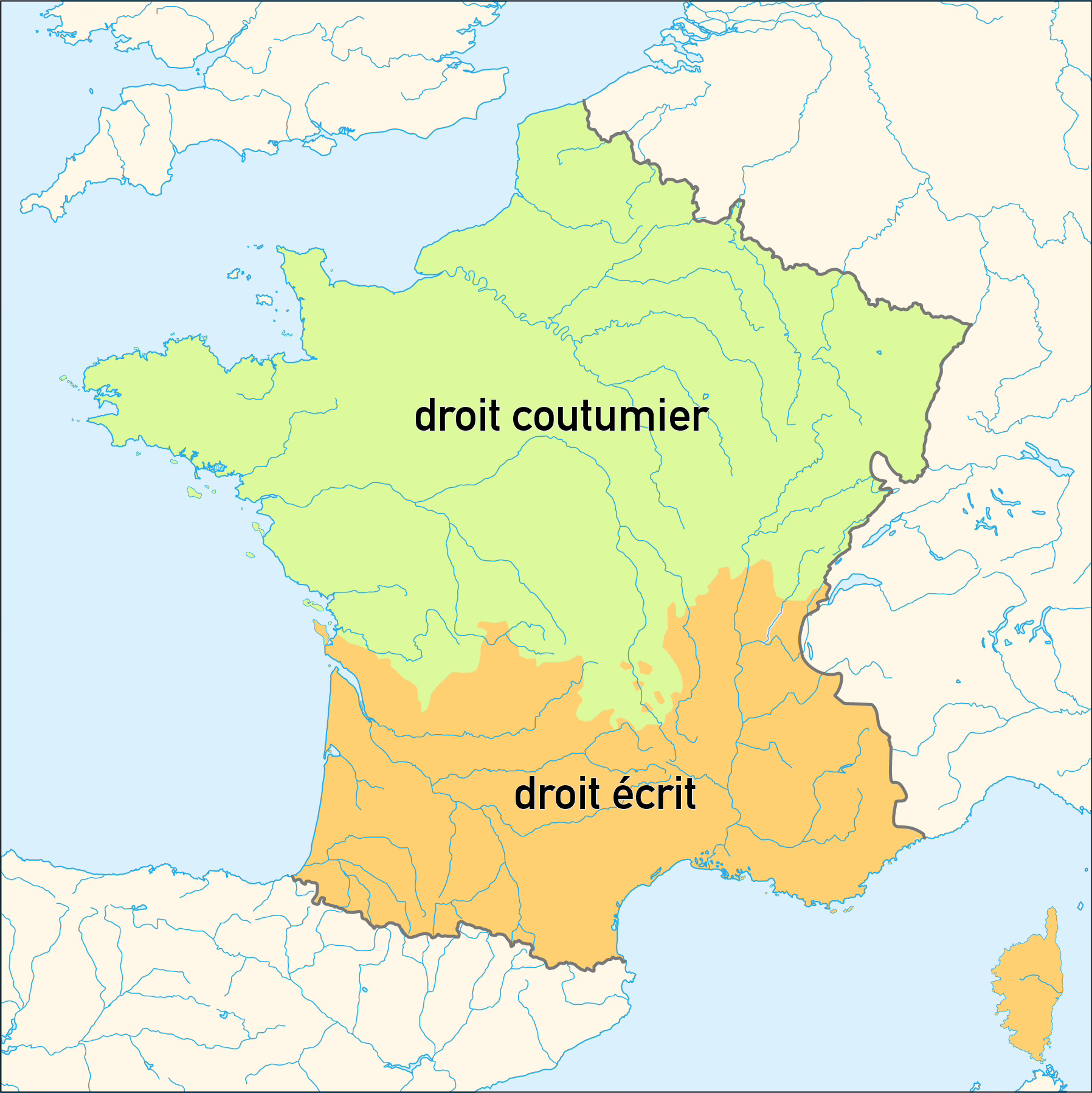
Prior to the French Revolution, French law was far from being unified. The prevailing system was layered and mixed, with civil matters following local customs at times, and Roman law at others. Even religious matters fell under their own canon. While the king sat above it all as a source of justice and supreme authority, he couldn’t change civil laws as they were a product of historical accumulation (ie, ancient, or a result of divine order) and existed independently of him.
This Ancien Droit reigned until the Revolution and reflected a kingdom that was not only still finding itself but that was split in other ways, such as between Oïl and Oc dialects, and pays de coutumes (spoken laws) and pays de droit écrit (written laws). The divide was both geographical, roughly along the Loire, and political. The south retained stronger Roman influence in both language and law, while the north developed along more local and partly Frankish lines.
The divide between types of laws continued for centuries, shaping legal practice across the kingdom without ever being fully resolved under the monarchy. It was only with the collapse of the old order at the end of the 18th century, followed by extensive reforms, that this long-standing legal duality was ended. The change came with Napoleon’s Civil Code of 1804, which established a unified legal system across all of France.
Not long after, in 1837, law student Henri Klimrath produced the first graphic representation of this historical divide, the Carte de la France coutumière, giving visual form to a boundary that had long structured the kingdom. The sinuous line ran from La Rochelle in the west to Geneva in the east. Klimrath would have relied on earlier compilations of the customs, such as Antoine Loisel’s Institutes coutumières (1607) and Bourdot de Richebourg’s Nouveau Coutumier général (1724) which were some of the most comprehensive sources available.
These compilations and maps preserved customs that had long existed in practice rather than by decree. They set the stage for customary law, rules that grew organically within communities and were later recorded in writing.
Spoken Law
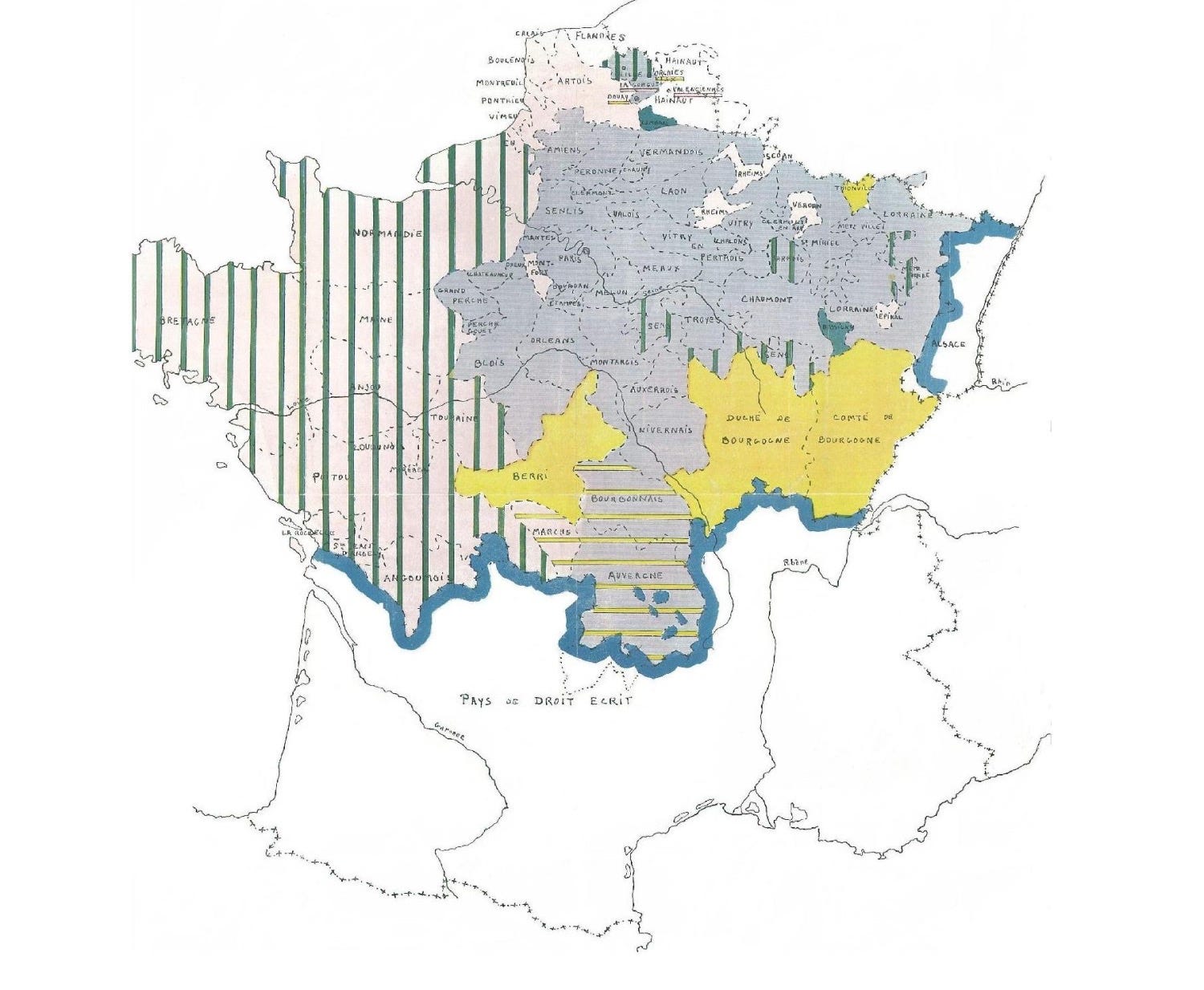
Spoken law in France came about “from the practice of acts, repeated and recognized, by the members of the same community on the same territory, for a period long enough to fix its continuum” [2]. Furthermore, it’s born from and used by the social group it applies to, in an organic, bottom-up manner that is as flexible as the speech it’s based on. Its origin can be found in the 11th century, in the web of loyalties and obligations between lords and their subjects, as well as in the local authority that lords exercised over their lands.
In effect, customary (spoken) law was the result of a need for practices to regulate everyday interactions. Practices that were too recent or lacked historical precedent could be challenged as mauvaise coutume, or a bad custom1. Likewise, customs that were no longer valid or useful could be discarded, showcasing a system that was both adaptive and flexible.
In the North, customs could be proved through the testimony of trusted local men in a procedure called the enquête par turbe2, showing how customary authority was fundamentally communal [2]. If their decision was unanimous, the custom was recognized as valid and could thereafter be treated as a coutume notoire, meaning it no longer needed to be proven in similar cases. This system continued until the Civil Ordinance of 1667, one of the major legal reforms under Louis XIV.
While these northern laws were oral in nature and transmitted that way, some were eventually written down, as previously mentioned. This included royal charters guaranteeing local customs as well as collections called customaries, where jurists recorded rules already familiar to inhabitants and those who governed them. These texts illustrate how oral law could be documented without changing its social and practice-based character. The recording of these customs also led jurists to consider whether they could serve as a model for other regions.

Celebrated French jurist Charles Dumoulin considered that the customs of his Parisian hometown, being the most refined and coherent, could be used for the entire country. Dumoulin’s aim was not to impose Parisian law by force, but instead to provide a foundational reference point when local customs were unclear or underdeveloped. This desire for a reference partly explains why some legal theorists later tried to draw comparisons between French spoken laws and Italian statuti, or medieval city statutes that were more akin to municipal legislation [3]. In Italian cities, if a statute covered an issue, it was applied; if not, jurists and judges fell back on the main European legal framework known as ius commune, of which Roman law was the dominant component (both served as a default system to fill gaps and guide interpretation).
Dumoulin opposed this comparison because it oversimplified inherently different legal systems. French customs developed organically from long-standing social practice and were recognized by the community, whereas Italian statutes were deliberately created as written legislation. He similarly rejected equating Roman law with common law, since each had different sources of authority and internal logic - views shared by his contemporary, French jurist Guy Coquille. While northern customs continued to develop organically, the foundations of written law in southern France reached back centuries.
Written Law

In the 6th century, after the fall of the Western Roman Empire, the Corpus Juris Civilis was commissioned by the Eastern Roman emperor Justinian. It was a systematic codification of centuries of Roman law intended to unify and clarify legal practice across the empire. Written law, by contrast, was created to cover most foreseeable cases and relied on theory and formal authority. Its development differed from customary law, which adapted organically from lived experience.
In the 11th and 12th centuries, this body of civil law was rediscovered in Italy and venerated as precedents from classical heritage. It soon spread to southern France. This wasn’t the start of pays de droit écrit in the region since pre-Justinian Roman law was already prevalent there and had influenced southern Gaul for centuries. What the Corpus did was standardize and formalize written legal tradition so that everyone in the legal field had a single body of work to refer back to.
Traveling notaries making their way from Italy into France - likely along the same paths used by itinerant peddlers - brought this revitalized set of laws into the Languedoc and Provence regions via trade routes in the late 12th century. In a region tied to Mediterranean trade and shaped by urban life, Roman law offered a degree of legal precision that made it especially attractive.
The transition was largely driven by the practical need to defend one’s property. Landowners quickly recognized that the rediscovered Roman law provided a technical advantage in court, governed by rules the profane couldn’t understand. It soon created a distinct professional class of jurists who traveled to Bologna for extended studies before returning to take up key administrative roles [4]. But a large class of notaries, who perhaps couldn’t afford to go to Italy, learned on the job, using Roman terminology to dress up medieval practices and get results that wouldn’t be possible had they merely followed one strict set of laws [5].
Roman law did not simply replace local custom. In many cases, local jurists borrowed its vocabulary and prestige while continuing to apply older practices. Its influence was often linguistic and technical, shaping the law in the south without entirely displacing what had come before.
Cases
Political expansion, such as the Treaty of 1259 between Saint Louis and the English king, helped solidify the boundaries of Capetian authority3 in France. These feudal fronts effectively made it so that certain regions were under different levels of royal control, which in turn reinforced the historical divide between customary law in the north and written, Roman-influenced law in the south. Local political relationships also played a role, as territories that submitted more fully to the French crown tended to fall on the customary side, while others kept written-law traditions [6].
Many examples survive of how this legal divide played out in practice, sometimes in ways that were highly technical and at other times almost absurd. The academic paper La France méridionale avait-elle une frontière sous l’Ancien Régime? covers such cases, three of which are below:
The Bridge at Saintes: In 1427, the Parliament of Paris had to investigate whether a specific court was located in the city of Saintes (written law) or on the bridge spanning the Charente river. Because the river served as the legal boundary, a courtroom’s physical position on the bridge determined whether a litigant had to pay a fine for an “unjustified appeal” (a penalty that only existed in customary law).
The “Odd and Even Months” of Cournon: In this Auvergne village, two separate jurisdictions (one written, one spoken) were eventually bought by a single lord. To resolve the conflict, a bizarre system was established: cases initiated in even months were judged by written law (appealable to Clermont), while those in odd months followed customary law (appealable to Riom).
The Split Households of Auvergne: In some areas, the legal border was so granular that it was said to pass through the middle of a street or even a single house. This led to inextricable situations where a person’s legal status, such as whether a minor reached adulthood at puberty (written law) or at age twenty-five (customary), could theoretically change depending on which room they were in.
End of the old divide

By the 18th century, France’s legal fragmentation had become a common object of criticism. Voltaire, a vocal opponent of spoken law, famously remarked that one changed laws in France as often as one changed horses. What had once reflected the kingdom’s long, layered history increasingly came to be seen as a problem.
The events of 1789 and the reforms that followed aimed to end that patchwork. While provincial privileges were abolished and regional divisions were broken up, departments were created to replace local differences with a single system. In legal terms, this was brought about by Napoleon’s Civil Code of 1804, which abolished the old customs and applied one civil law across France.
Even so, the transition was not exactly immediate, and legal voids still existed. Revolutionary governments had not managed to legislate for every area of civil life, and older customs sometimes continued to be applied out of necessity until the Code was fully implemented. Even after 1804, older legal situations, such as inheritances and marriages contracted under provincial custom, could still be judged according to the previous rules.
Yet the disappearance of the old divide didn’t mean its legacy vanished. The Napoleonic Code itself retained aspects inherited from both spoken law and written law, preserving a unified version of what had once existed in parallel. In that sense, the Code didn’t erase the legal history of France so much as absorb and reorganize it.
This larger movement toward standardization was not limited to civil law alone. Royal efforts to impose uniformity had already extended into language and administration centuries earlier, most famously with the Ordinance of Villers-Cotterêts in 1539, which required all legal and administrative acts to be written in French rather than Latin, laying a foundation for centralized authority.
For most of its history, France did not operate under one rule of law but under several, depending on where one stood (including literally). The divide between spoken and written law reflected older regional worlds that long survived inside the kingdom. The Civil Code of 1804 finally closed that chapter, replacing local variation with a single, national system, but it did so on the shoulders of the customs and Roman principles it inherited, absorbing centuries of layered legal history instead of erasing it.
Additional Information
Captions for the spoken laws map: grey (applies only to real estate); off-white
(applies to lifetime gifts); green vertical stripes (acquired property can be subject to the area); yellow horizontal stripes (applies to the property of the deceased); yellow (excluded in favor of Roman legal principles); green (leaves both the reserved portion for heirs and the disposable portion undefined).
Sources
1 - Aux origines de la réserve héréditaire du Code civil : la légitime en pays de coutumes (xvie-xviiie siècles)
2 - La coutume: conserver, rédiger et réformer
3 - Le droit commun en France selon les coutumiers
4 - Le droit féodal dans les pays de droit écrit
5 - Pratique notariale et droit romain dans les pays de droit écrit
6 - La France méridionale avait-elle une frontière sous l’Ancien Régime?
one in Vermandois reportedly forbade righting an overturned cart without the lord’s permission
a group of several wise and experienced men (that is, older men practiced in the law)
aka House of France, a dynasty of Frankish origin, who ruled the country without interruption from 987 to 1792, and from 1814 to 1848