


Centuries after Dante and Petrarca, Italy produced a style of writing that freed the Italian language from its constraints. No longer would elements like syntax, punctuation and adjectives rule the way Italians expressed themselves on paper. Instead, nouns would randomly hit the page, joined with mathematical signs and musical symbols.
The 20th century, being one of progress, meant that dynamism and speed would be the new way of life. Wars, wireless telegraph, the radio, airplanes, and cameras altered the idea behind distances and time. Movement itself called for a style that matched it. In the words of the man who found a way to convey it:
The rush of steam-emotion will blow apart the pipe of the sentence, the valves of punctuation, and the regular bolts of adjectival decoration.
It was 1912-13 when Italian poet Filippo Marinetti, founder of futurism, introduced the literary side of the movement, known as “parole in libertà” (words in freedom). This push for liberated words was laid out in his second and third manifestos1, however they existed upon the foundations he laid out years earlier.
Birth of Italian Futurism
In 1902, his first poetry book La conquete des étoiles showcases Symbolist/proto-Futurist elements, like loosened syntax, free verse, repetition and exclamatory energy, as can be seen in the opening lines:
Hola-hé ! Hola-hé ! Hola-ho !
O Vagues antiques, ô Vétérans de la Mer Souveraine, debout, guerriers puissants aux barbes vénérables d’écume!
Debout ! Debout, nos frères !
Yet, Italian futurism itself was born from a collision, both figurative and literal. In a 1908 car crash, while trying to steer clear of two cyclists, Marinetti’s high-end motorcar crashed, sending him into a ditch. Upon being fished out, he felt determined to free himself from decorative excesses and refined aestheticism.
One year later, Marinetti’s Manifesto del Futurismo debuted in four Italian newspapers and then on the front page of the Parisian newspaper Le Figaro [1]. Aside from it laying out the eleven tenets of the movement, he concludes with a fervent argument in two parts. In one, he lambasts the existing cultural order which he sees as the status quo of reverence:
Italy has been too long the great second-hand market. We want to get rid of the innumerable museums which cover it with innumerable cemeteries […] To make a visit once a year, as one goes to see the graves of our dead once a year, that we could allow! We can even imagine placing flowers once a year at the feet of the Gioconda!
And in the second part of his argument, he targets his own revolution, saying he doesn’t seek to replace the old canon with a new permanent one. Rather he expects to be overthrown and even invites it. In other words, constant generational destruction:
The oldest among us are not yet thirty years old: we have therefore at least ten years to accomplish our task. When we are forty let younger and stronger men than we throw us in the waste paper basket like useless manuscripts!
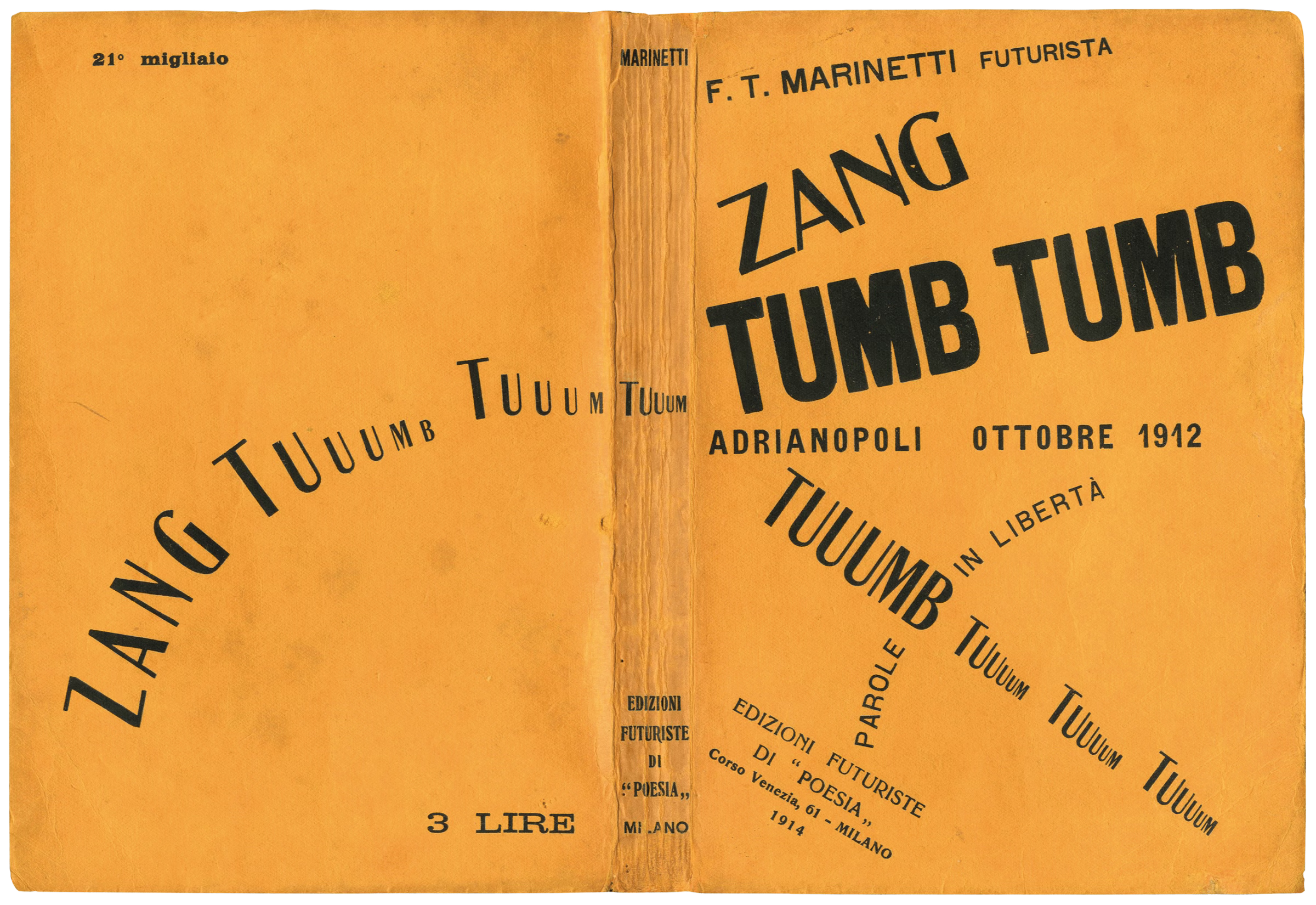
His style evolved further with the 1914 novel Zang Tumb Tuuum. It’s a first-hand account of the siege of Adrianople in the Balkan War, which Marinetti had witnessed as a war reporter. The title reflects mechanical noises, with zang representing the firing of an artillery shell; tumb, its explosion upon impact; and tuuum, the resulting echo. In his signature style, the book closes with the following [2]:
These weights thicknesses noises smells molecular whirlwinds chains webs corridors of analogies rivalries and synchronisms offered offered offered offered up as a gift to my Futurist friends poets painters musicians and noise intoners.
Word Tables


One year after Marinetti launched Futurism, a group of painters in Milan published their own Futurist manifestos, establishing Futurist painting as a distinct sub-movement. Like the literary side, they rejected reverence for the past and found inspiration in the energy and chaos of contemporary life. This radical experimentation aided in the development of a visual component to liberated words.
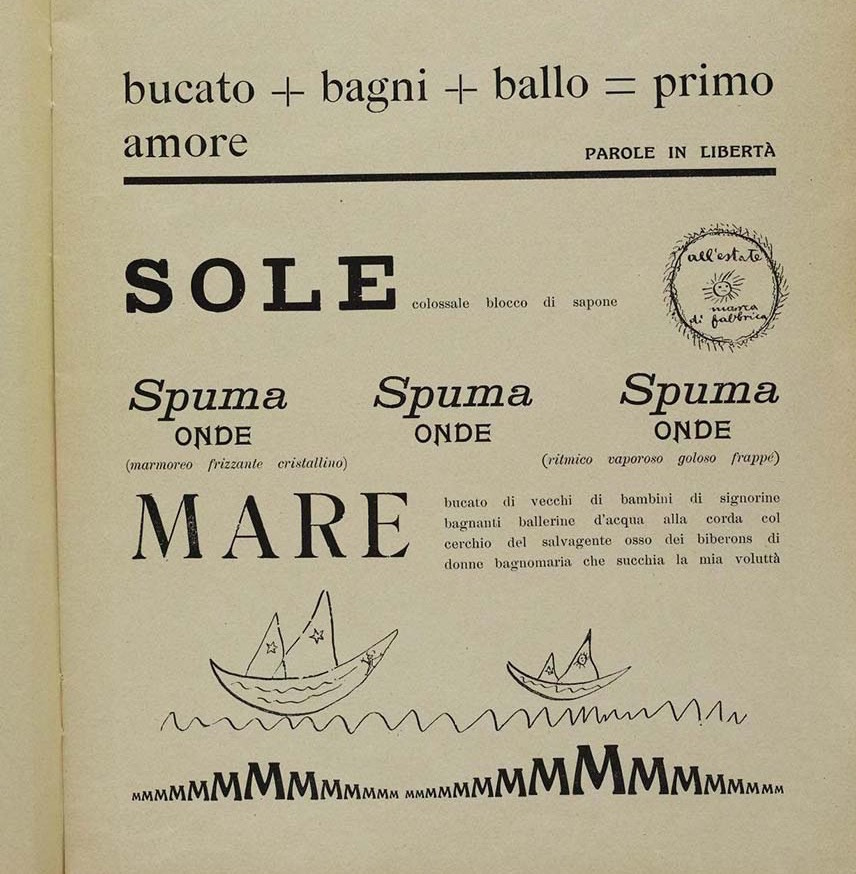
This flows from Marinetti’s prescription for Futurist writing, which was not only phonetic but also visual, inspiring the invention of specific tables of words (tavole parolibere). Italian Futurist artists such as Pino Masnata and Fortunato Depero ran with the style, making it their own. Masnata’s work carried a multi-dimensional approach that was sometimes described as poliespressività, combining visual, verbal, and auditory elements.
These word sets displayed a “graphic-verbal duality” and “phonic-verbal communication”. In other words, texts of poetry resolved into graphic form, expressing themselves through fragments of images, sounds, noises, onomatopoeias, metaphors and synesthesias. Other Futurists, like Ardengo Soffici, also explored the word-table format: his 1915 artist’s book BÏF§ZF+18 is considered one of the most accomplished examples of Florentine Futurist words-in-freedom, in which he adapted the movement’s experimental spirit.
Conclusion
Futurism would continue to evolve with a second wave a decade after the first wave had begun. The newer version was a more fluid and less rigid movement than the first, freed from the voice of Marinetti and with more room to experiment.
FT Marinetti tried to dynamite grammar (and that’s not all2). But nobody replaced Dante Alighieri. The shockwaves of Futurism were absorbed and filtered through centuries of literary and cultural tradition. The experiments with the avant-garde couldn’t replace all that came before. Europe’s strength is that it can confront radical upheavals and continue to produce works of enduring beauty and thought. It also turns out that Marinetti and Soffici championed Fascism, which history did not look kindly on. And much like that political current, they left their mark but couldn’t erase the foundations that came before.
Additional reading
1 - The Futurist suit becomes anti-neutral (Historia Minuta)
Sources
1 - The Futurist Manifesto
2 - Italian Futurism 1909-1944
3 - Tavole parolibere
4 - Montagne russe a Coney Island, Fortunato Depero, 1930
Manifesto tecnico della letteratura futurista & Distruzione della sintassi/Immaginazione senza fili/Parole in libertà
Marinetti wrote a cookbook and a manifesto to broadcast his ideas about the Futurist meal. In particular, he declared a war on pasta, arguing that it made people “skeptical, slow and pessimistic”.