


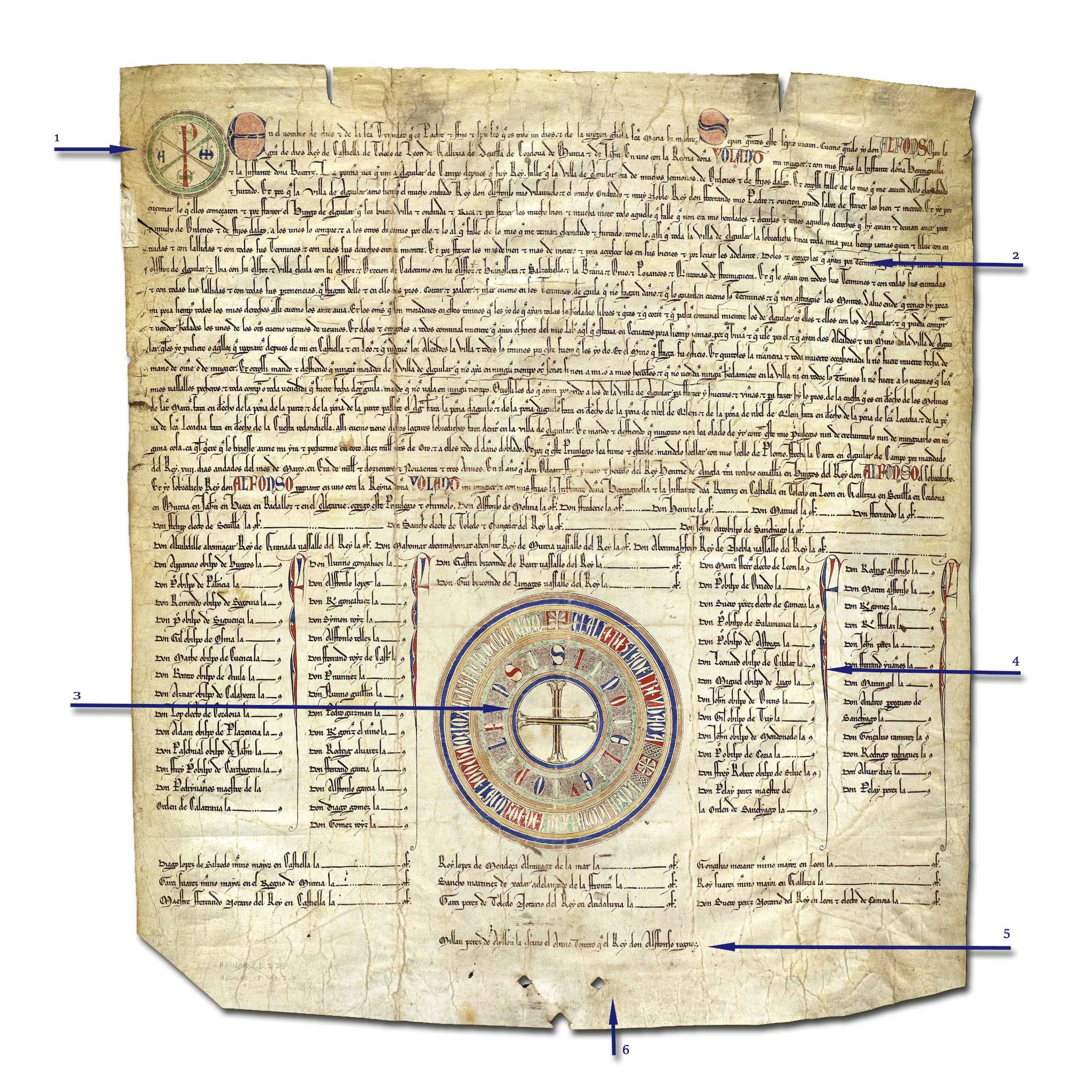
In the courts of medieval Spain, royal authority was made visible through symbols as well as decrees. In Castile and León, when the king needed to grant a courtly privilege (such as donations of land, tax exemptions, market rights, or confirmations of earlier favors), royal charters were used with formal and visually impressive signs known as privilegios rodados.
Its introduction in Hispanic documentation is linked to the famous Archbishop Diego Gelmírez in Santiago de Compostela. During his stays in Rome, Gelmírez became familiar with the papal rota, a circular sign used to authenticate documents1 in the tradition of medieval diplomatics2. Once in Galicia, he began using a similar sign from the year 1115 in his own charters as a mark of authority [1]. The use of the privilegio rodado was primarily Iberian, even though it took its inspiration from Rome.
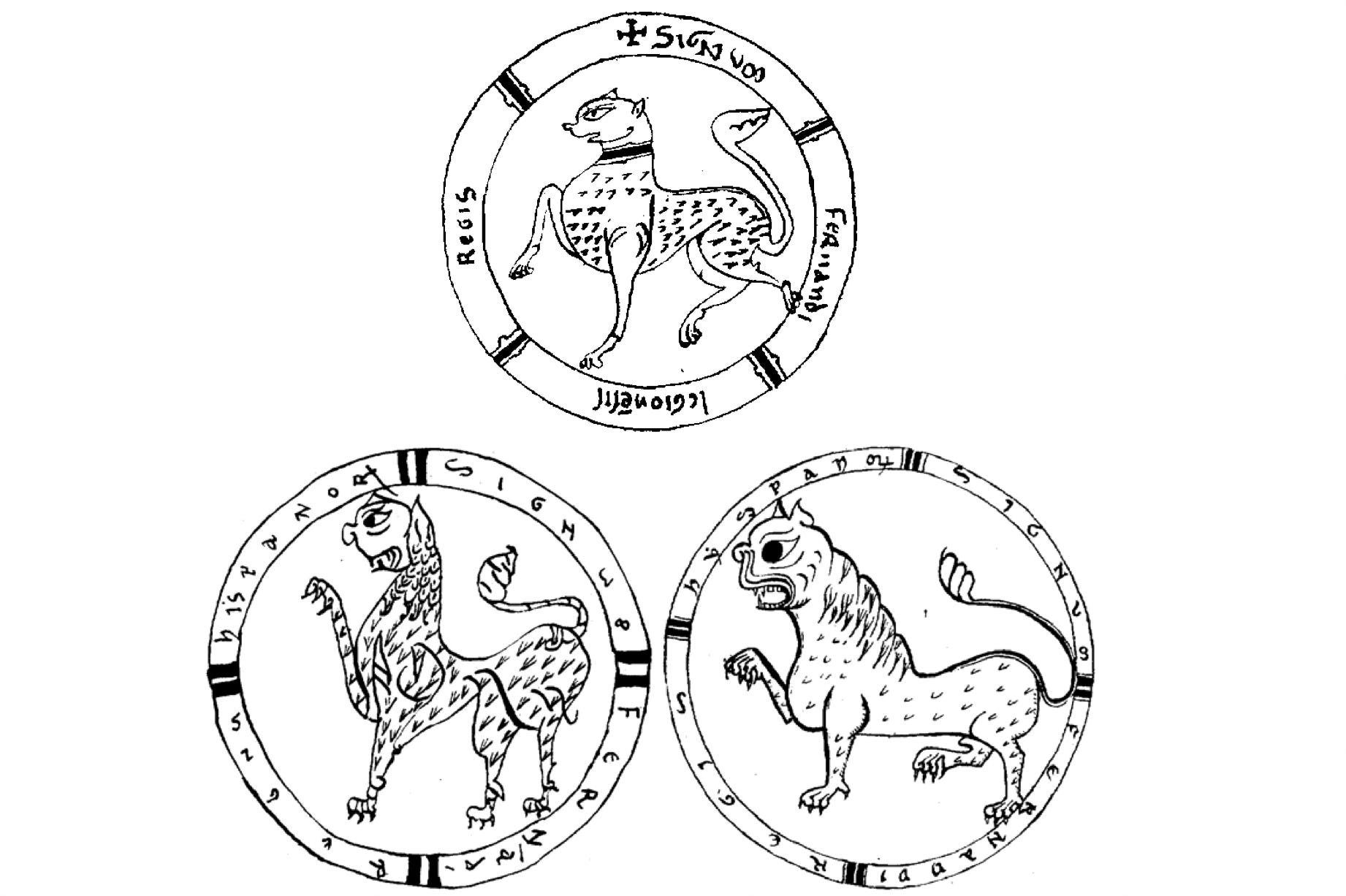
Before the privilegio rodado took its mature form, royal symbolism in León was already evolving. The circular wheel offered a model for expressing authority in documents. Alfonso VII of León and Castile employed the lion as a personal emblem linked to royal strength and the kingdom of León, but under Fernando II of León it became a clearer territorial symbol when incorporated into the king’s official sign. This integration helped establish the wheel as a central marker of royal legitimacy, paving the way for the privilegio rodado later standardized in Castile.
Building on these developments, Alfonso VIII was the first Castilian king to issue privilegios rodados with pendent lead seals (between 1175 and 1212), setting the standard for elegance and authority [2]. Collections featuring around 100 examples survive today, such as in the Archivo de la Casa Ducal de Medinaceli located in Toledo [3]. Over time, the privilegio rodado developed from these early examples, reaching its most elaborate form under Alfonso X, illuminated in vivid colors and gold, with ornate script.
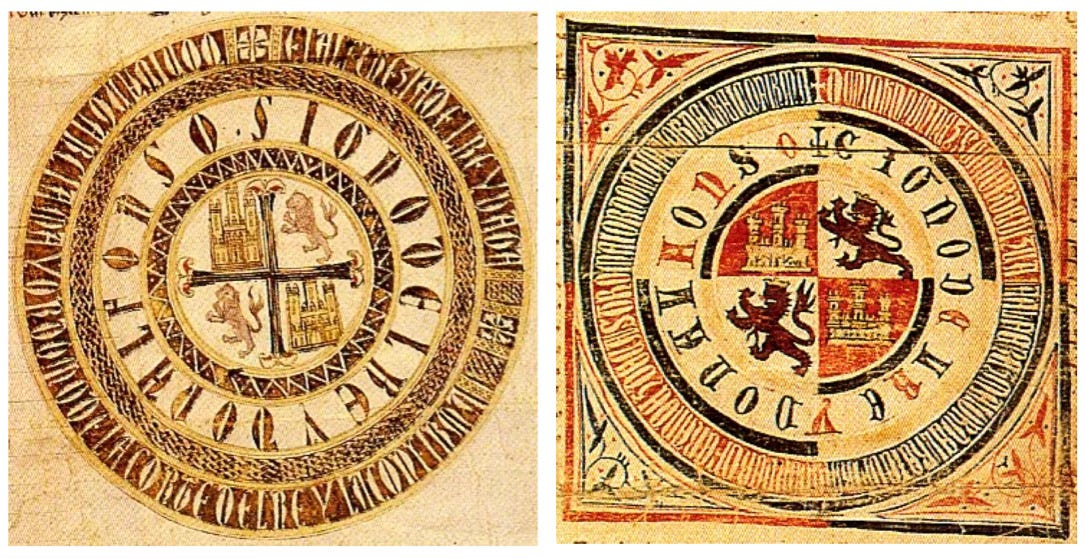
The important symbols on these charter documents consisted of a signum regis: a large circular wheel drawn in the document, featuring a cross, emblems like a lion or castle, the king’s name inside, and officials’ names outside [1]. Often, the document included the intertwined Greek letters chi (X) and rho (P) to invoke Christ and signify that the king’s authority derived from God. Finally, a plumbum (pendent lead seal) hung below to provide legal authentication and protect against tampering.
After the union of Castile and León in 1230 under Ferdinand III, the Castilian cross prevailed while the Leonese lion was removed. The wheel grew larger and more decorative while the phrasing around it expanded to reflect the crown’s widening territorial claims (ex. Córdoba, Murcia, Jaén, Seville) [1]. In the reign of Alfonso XI, the cross was removed, leaving just the signs of the realm in the center.
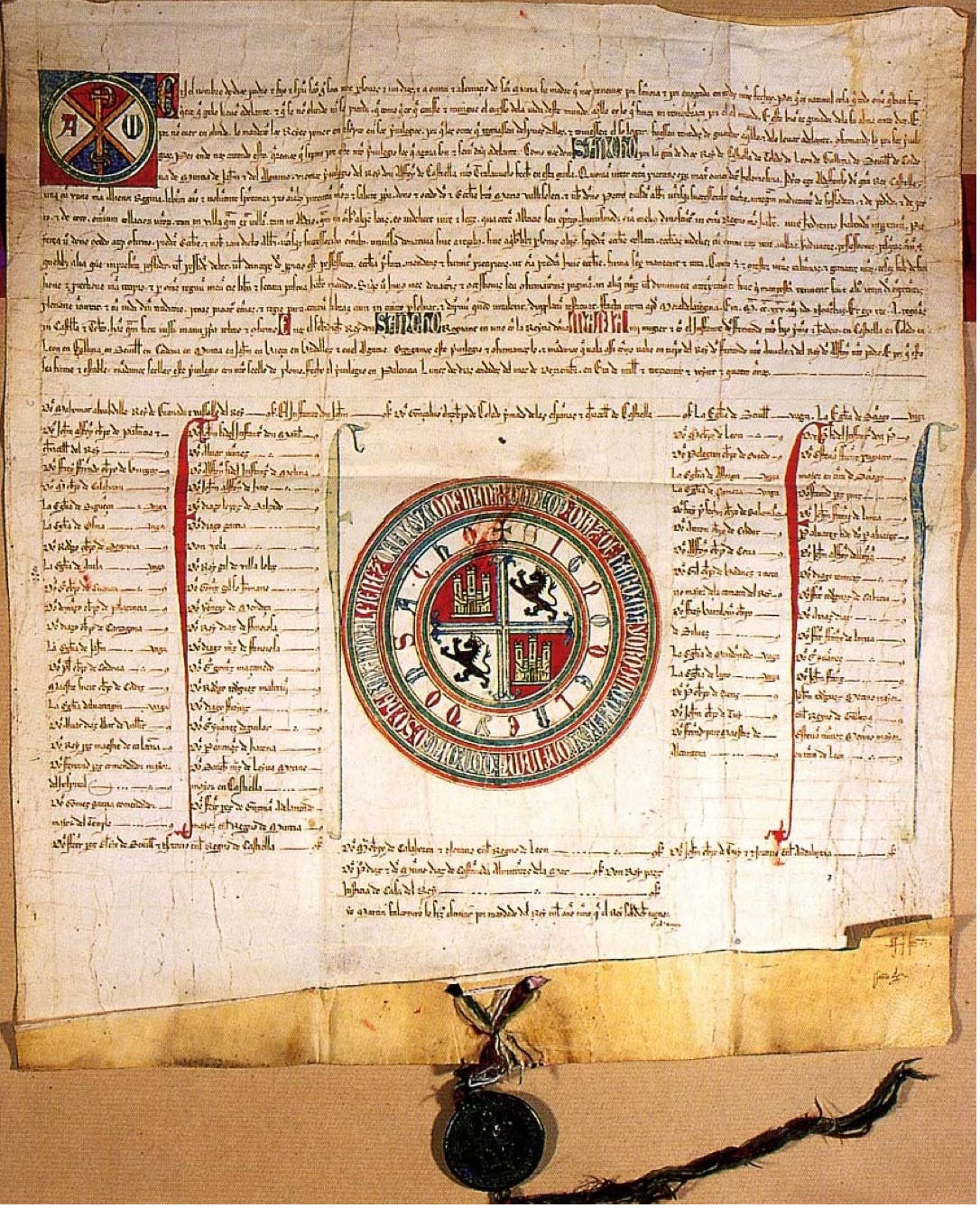
Despite their elaborate design and symbolic weight, these charters were functional objects intended for specific recipients. They rarely “traveled” and were usually given directly to the beneficiary (town council, monastery, church, or noble) for archival storage. Before being stored, however, they were exhibited or read aloud publicly to affirm rights in disputes, ceremonies, or assemblies. The elaborate visual elements emphasized stateliness and propaganda, meant for viewing by relevant audiences rather than remaining unseen.
In the medieval world, the distinction between private and public separated everyday dealings among individuals from matters concerning the crown and the realm [4]. Whereas private exchanges relied on personal trust or custom, acts undertaken in the king’s name demanded visible symbols that projected legitimacy and made authority publicly recognizable.
By the late 15th century, the consolidation of royal administration and standardized record-keeping made such highly ceremonial displays unnecessary. Authority was now guaranteed by bureaucratic control and archival registration. In this sense, the disappearance of the rueda marks the passage from a performative medieval kingship to the documentary culture of the early modern state.
Sources
1 - El Signo Rodado Regio en España. Origen, Desarrollo y Consolidación. Siglos XII-XV
2 - Los “Privilegios Rodados” originales del Archivo Ducal de Medinaceli: Alfonso VIII de Castilla (1158-1214)
3 - The Ducal Archive of Medinaceli
4 - The Origins of the Modern Public [14-part podcast, & original link]
5 - Los códigos visuales del privilegio rodado en tiempo de Alfonso X
originating in the papal documents of the famous German pope Leo IX (1049–1054)
a discipline originally evolved as a tool for studying and determining the authenticity of the official charters and diplomas issued by royal and papal chanceries